
Learning from Disasters in Scholarship & Practice: A South-North Knowledge Exchange between Nepal and British Columbia
Workshop: March 10, 2026
Report published: May 2026
Download a PDF version of this report
Introduction
“Learning from Disasters in Scholarship and Practice: A South-North Knowledge Exchange between Nepal and British Columbia” was held on March 10, 2026, in the Place of Many Trees at the Liu Institute for Global Issues on the traditional, ancestral, unceded lands of the xʷməθkʷəy ̓əm (Musqueam), where the University of British Columbia (UBC) is situated. The workshop was convened by Sara Shneiderman, as the Ivan Head South-North IDRC Chair, and was co-sponsored by UBC’s Disaster Resilience Research Network (DRRN), Himalaya Program, Jean Monnet Centre of Excellence in Critical Infrastructure Studies, School of Public Policy and Global Affairs (SPPGA), and Faculty of Arts, along with the Pacific Institute for Climate Solutions (PICS) through a knowledge exchange grant.
Nepal and British Columbia (BC), Canada, face increasing exposure to multi-hazard risks across complex riverine and mountainous landscapes, which are shaped by climate change and seismic vulnerability. Following the devastating 2015 earthquakes, Nepal developed a federal, multi-hazard disaster governance framework through the Disaster Risk Reduction and Management Act of 2017. This led to the establishment of the National Disaster Risk Reduction and Management Authority (NDRRMA),with a focus on inclusive planning with Indigenous and marginalized communities. In parallel, BC has strengthened its institutional and legislative framework by establishing the Ministry of Emergency Management and Climate Readiness (EMCR) in response to recent extreme events.
By bringing participants from these different contexts together, the workshop aimed to facilitate a mutual exchange of policy-relevant knowledge between the Global South and Global North to support the development of disaster risk reduction strategies for the future. It also sought to develop a plan for ongoing knowledge exchange and collaborative research partnership. A diverse group of scholars and practitioners whose work focuses on disaster resilience, governance, and preparedness in Nepal and BC came together for an intensive day of conversation. Participants included scholars from various faculties at UBC, including Applied Sciences, Arts, Forestry and Environmental Stewardship, and Law, as well as other academic institutions like British Columbia Institute of Technology, Tribhuvan University, and Social Science Baha. Other participants included representatives of civil society organizations such as First Nations Emergency Services Society (FNESS) and Preparing our Home, along with officials from the BC provincial and City of Vancouver municipal governments. The workshop was structured around three roundtable discussions, each of which engaged participants from both Nepal and BC around shared themes of interest and expertise.
Disaster Governance Across Jurisdictions

The first roundtable featured Amanda Broad, Jocelyn Stacey, Ganesh Dhungana, and Jeevan Baniya (see Presenter Bios at the end of this report). This session was moderated by Jonathan Eaton. The panelists reflected on how the anticipation of disasters informs and shapes socio-political transformations to establish a framework for addressing time-sensitive risks.
Amanda Broad discussed BC’s 2025 Disaster and Climate Risk and Resilience Assessment report. She emphasized that the development process for various jurisdictions lays the groundwork for addressing hazards to critical infrastructure and human safety. Key insights from the assessment include the importance of equity and intersectionality, and the need to advocate for the involvement of those disproportionately affected by disasters in strategic planning. Broad recommended using Indigenous and values based frameworks to create a resilient strategy for decision-making and knowledge sharing. She stressed the need to build trust and shared value with stakeholders through cultural safety and safe spaces for knowledge exchange.
Ganesh Dhungana presented Nepal’s BIPAD Information Platform, which provides real-time statistical calculations of natural hazards and disasters. It enables local governments to contribute data accessible to the public and record damage, hazards, and incidents. Dhungana proposed a technical knowledge exchange between Nepal and BC, where Nepal could share lessons learned about establishing multi-hazard information systems like BIPAD, while BC can provide experience with the values-based approach to enhancing disaster management capacity.
Jocelyn Stacey presented on multi-jurisdictional disaster governance in BC, describing new provincial emergency management legislation (Emergency and Disaster Management Act) enacted in 2023. One of BC’s intentions with the new legislation was to shift from reactive responses to prevention, risk reduction, and recovery, shaped by past wildfires, the pandemic, and heat domes. BC’s legislative commitment to the UN Declaration on the Rights of Indigenous Peoples (UNDRIP) also informed development of the new legislation. Stacey highlighted some of the new mechanisms for coordination that are enabled by this legislation, specifically: provincial powers to enter into agreements that uphold First Nations’ consent and their own laws and protocols in relation to emergency management, a new model of emergency program in the form of a multi-jurisdictional emergency management organization, and expanded obligations on the province and other emergency management actors to consult and cooperate with Indigenous governing bodies.
Jeevan Baniya’s presentation focused on the aftermath of Nepal’s 2015 earthquake and the subsequent adoption of a new constitution that encourages federal, provincial, and municipal governments to collaborate on disaster preparedness through disaster risk reduction (DRR) policies. Baniya's research through the Sajag-Nepal Project highlights improvements in disaster preparedness at the local level resulting from consultations with municipal governments. However, Baniya pointed out that despite the Government of Nepal’s commitment to DRR policies, budget allocations strongly prioritize infrastructure development, potentially increasing disaster risks. Additionally, federal and provincial projects often limit local government influence, leading to coordination challenges and forms of ungovernable disaster risk.
Indigenous Knowledge & Disaster Management

The second roundtable focused on experiences from different Indigenous contexts in BC and Nepal, presented by speakers Casey Gabriel, Lily Yumagulova, Mukta S. Tamang, Katherine (Kaye) Bright, and Owen Price. SPPGA Policy Practitioner fellow Jen Walker moderated.
Casey Gabriel and Lily Yumagulova presented their work with Preparing Our Home, a Canada wide organization focusing on Indigenous Emergency Management where emergency preparedness is decolonial, community-based, and strength-based, steering away from individualistic and deficit-based forms of emergency preparedness dominant in Western approaches. Their youth mentorship program focuses on intergenerational, youth-led emergency planning, highlighting the importance of reflecting on what reciprocity looks like while working with Indigenous communities, and most importantly, what disaster response look like when it meets communities along their own lines of kinship.
Mukta Tamang spoke about his research on how the 2015 earthquakes and subsequent disasters have disparately affected Indigenous communities in Nepal. In 2024, cascading episodes of heavy rainfall and landslides destroyed houses, crops and roads in Tamang’s village of Harre. Tamang highlighted community responses to these events, emphasizing how they revisited traditional community practices to create strategies for survival. Community members understood the event not only as a disaster, but as a rupture of relationships between human beings and nature, between human beings and more-than-human spirits and deities who live in the landscape. In highlighting these practices, Tamang pointed to two things: firstly, government response is often minimal, and secondly, modern scientific knowledge is not enough to understand and predict multi hazard risks. He ended the presentation with the question: How do we balance relationships between humans, nature, and non-humans in a global disaster context?
Kaye Bright and Owen Price, representing First Nations Emergency Services Society (FNESS), a charitable non-profit that delivers services in First Nations communities in BC, presented a short video on the media coverage of wildfires and how the affected people are sometimes forgotten. The video focused on communities along the Nicola River and Cooks Ferry during the floods of 2021, which affected three First Nations communities, displacing community members and leaving a path of destruction in their wake. Upon safe return to the community, an elder in the video described the community and land as “the place where my spirit is… this is my grandfather’s land”. The video made a clear point that this was not just another address along Highway 8; that when disasters displace people, they also displace people from their resources and their relationships. Bright and Price presented their experience and observations of how small communities may not have enough capacity to respond and are also often forgotten by emergency response initiatives. FNESS particularly supports such communities.
Managing Multiple Hazards
The third roundtable was moderated by Philippe Le Billon, and convened four speakers: Sarah Dickson Hoyle, Ivan G. Somlai, Bishnu Pandey, and Michele Koppes, who presented hazard specific lessons and insights from Nepal and BC.
Sarah Dickson-Hoyle shared her experiences conducting collaborative wildfire research in BC, including with Secwépemc Nations communities, and spoke to the impacts of compounding hazards on these communities and territories. She also highlighted research that identified key barriers to communities implementing wildfire risk reduction, including a lack of provincial and federal funding, insufficient time allocated to staff workload, and lack of technical knowledge, and emphasized the role of Community Forests in leading local approaches to proactive wildfire management. The primary takeaway was that building trust and relationships can enable collaborative approaches to wildfire risk reduction. In addition, Dickson-Hoyle prioritized community needs and control over forest management decisions and restoration for wildfire resilience and health forest management.
Iván Somlai examined the complex governance structure of forest fire management in Nepal, emphasizing the interplay between domestic institutions and external actors. He explained that forest fire response involves overlapping responsibilities across multiple stakeholders, requiring coordination and collaboration that is difficult to sustain. Further, he highlighted that external assistance in Nepal’s forest fire management is often shaped by foreign funding dynamics, and reliance on external aid therefore creates structural dependence, undermining locally driven solutions. Moreover, political instability in Nepal has constrained forest fire governance by compromising institutional continuity and limiting effective policy implementation. The presentation concluded by stressing the importance of incorporating local knowledge and collaborating with external actors advisedly (i.e. with careful thought) to develop effective wildfire governance and management programs.
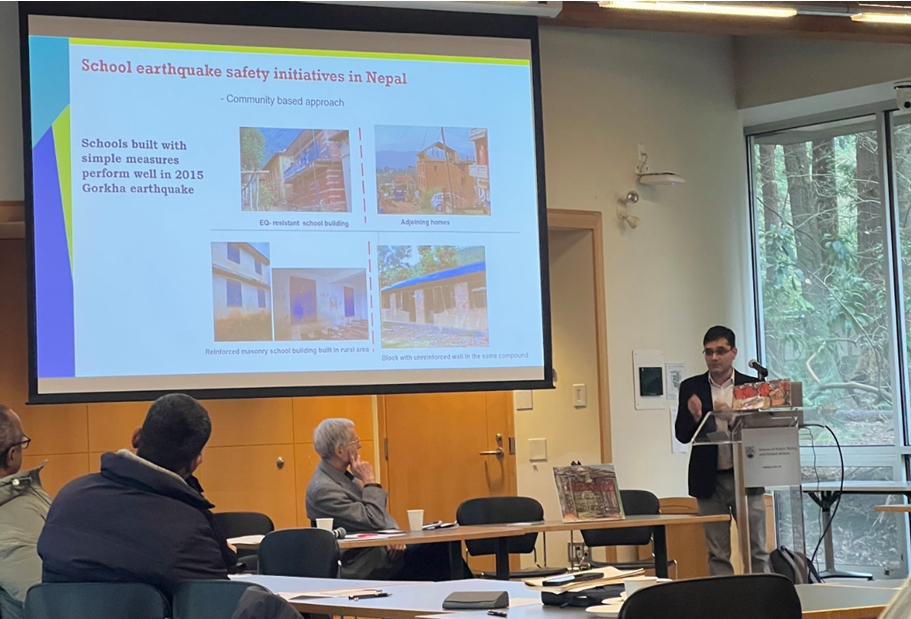
Bishnu Pandey’s presentation focused on seismic safety of schools and communities, through the framework of community-based retrofit programs in BC and Nepal. Earthquakes pose a significant risk to school safety, contributing to a concerning number of student fatalities across both developing and developed countries. Pandey explained how the provincial school Seismic Mitigation Program in BC integrates expert knowledge with collaboration between governments and community members to strengthen seismic resilience. This community-centred model took some inspiration from Nepal, where retrofitting efforts before the 2015 earthquakes involved multiple stakeholders and engaged the local community to improve safety outcomes. Pandey underscored the importance of raising public awareness and strengthening collaboration across academia, government and industry to facilitate knowledge exchange and build local capacity for context-specific interventions.
Michele Koppes presented research on the cascading effects of climate change in high mountain communities, focusing on how retreating glaciers and diminishing snow/ice masses create complex, interconnected hazards that extend far beyond immediate impact zones. Koppes drew from case studies with the Sherpa community in Thame, Solukhumbhu, Nepal, and the Lil’Wat Nation in Pemberton Valley, BC to show how co-developing responses to the climate crisis includes iterative processes, trust building between researchers and communities and strategic time and resource allocation.
Key Learnings & Concluding Questions

UBC Dean of Arts Clare Haru Crowston offered opening remarks for the concluding session, during which participants worked towards a synthesis of key learnings and questions for future collaborative research. Facilitated by Sara Shneiderman and Jonathan Eaton, this session created interactive opportunities for participants to reflect upon both the convergences and divergences between these South-North contexts. An important recurring theme was the realization that there was no ‘one-size fits all’ approach to disaster preparedness or response. Speakers talked about the need for deeply reflecting on what meaningful engagement and relationship building looks like in different community contexts, how intergenerational spaces for knowledge transmission can be created, what shared partnership and power sharing can look like, and the need for case studies that have successfully demonstrated such collaboration. There was also general agreement about the need to dismantle the assumption that the Global North will always lead technical innovation and share it with the Global South. Instead, we can flip the script to treat knowledge as flowing in all directions, with key innovations emerging in the Global South with subsequent application in the Global North, as well as the other way around. Indigenous Knowledge from across global contexts is an important part of this process but cannot fix everything on its own. Mobilizing Indigenous Knowledge also requires care when it comes to documentation and implementation, and such policy processes should be Indigenous-led.

Participants identified several questions for future discussion and potential research partnership:
Identifying strategies for engaging youth as emergency preparedness leaders, both within their families and within broader communities, felt important to everyone. We wondered what Nepal’s recent youth-led political transformation might mean for disaster preparedness there, and what lessons might be relevant for BC’s policy landscape?
A consensus emerged that beyond experiencing many similar hazards (earthquake, landslide, fire, flood), Nepal and BC also share the challenges of navigating risk across diverse, multicultural populations who live across equally diverse rural and urban geographical spaces, each of which requires its own approach to disaster governance. How can we develop frameworks for understanding commonalities across difference, both within individual jurisdictions and across them, while not reducing all resonances to being ‘the same’?
While there is significant funding for climate related research in both Global North and Global South contexts, participants felt that funding streams are often siloed by hazard. We wondered how to build bridges across hazard specific silos, in ways that enable research to travel more easily across contexts, as well as across sociotechnical divides?

Much funding is project-based on relatively short timelines. We wondered whether there are prospects for establishing sustainable disaster research centres in BC, Nepal, or elsewhere, that could house the kind of exchange that we experienced in this workshop, eventually leading to cutting-edge collaborative research?
With such questions guiding us towards the next steps, this workshop served as an important initial opportunity for South-North knowledge exchange between Nepal and BC. It brought together scholars, practitioners, and government representatives, demonstrating how interjurisdictional and transdisciplinary learning can enhance disaster resilience. The discussions highlighted the importance of equity and inclusion for Indigenous and marginalized communities before, during, and after disasters and showcased diverse regional approaches to disaster risk reduction. Overall, the workshop established a foundation for future partnerships and research initiatives focused on improving community resilience and creating adaptive disaster governance frameworks that prioritize safety for all in the face of climate change and the full range of disasters.
Presenter Bios
Prior to the workshop, participants were invited to submit a brief bio and links to relevant materials.
Jeevan Baniya
Deputy Director, Social Science Baha; Research Director, Centre for the Study of Labour and Mobility (CESLAM), Kathmandu, Nepal
Dr. Jeevan Baniya holds a PhD in Political Science from the University of Oslo and has served at Tribhuvan University as an adjunct faculty member. At Social Science Baha, he leads research on inclusive governance, disaster impacts, social inclusion, and labour and mobility. He has provided advisory and technical support to the government agencies and International Labour Organization.
Reconstructing Nepal
Sajag-Nepal: Planning and Preparedness for the Mountain Hazard and Risk Chain
After the Earth's Violent Sway: The Tangible and Intangible Legacies of a Natural Disaster
Katherine (Kaye) Bright
Strategic Partnership and Community Engagement Advisor, First Nations’ Emergency Services Society (FNESS) Kaye Bright has over a decade of experience supporting First Nations communities across British Columbia. As the Strategic Partnership & Community Engagement Advisor at FNESS, she plays a key role in advancing community-led disaster risk reduction, interagency collaboration, and emergency planning for First Nations communities. With a strong background in both operational response and strategic program development, Kaye has led initiatives focused on capacity building and risk assessment, contributing to disaster risk and reduction strategies. She previously served as Decision Support Supervisor, Community Support & Preparedness Specialist, and Regional Recovery and ESS Specialist at FNESS, where she supported emergency management planning, training, and response efforts tailored to First Nations communities, and also worked with the Ministry of Emergency Management and Climate Readiness (EMCR) as an Emergency Management Technician, participating in provincial deployments and coordinating multi-agency support during wildfire, flood, and public health emergencies.
FNESS Info
Amanda Broad
Manager, Disaster Mitigation & Adaptation Policy, Ministry of Emergency Management and Climate Readiness, Government of British Columbia
Amanda Broad is a disaster risk and resilience professional working in policy and practice for the Ministry of Emergency Management and Climate Readiness in British Columbia, where she leads work on disaster mitigation, adaptation, and risk reduction. In this role she contributes to the development of strategies and frameworks that inform community disaster preparedness, climate resilience planning, and hazard governance across multiple contexts. Her work focuses on collaborative approaches to understanding and reducing risk, supporting community-led resilience, and integrating climate and disaster risk assessment into public policy and planning processes.
British Columbia Disaster and Climate Risk and Resilience Assessment, Oct. 2025, Summary for Policymakers
Ganesh Dhungana
Postdoctoral Research Fellow in Disaster Resilience, Department of Civil Engineering, University of British Columbia; Director, Youth Innovation Lab
Dr. Ganesh Dhungana is a disaster resilience researcher with expertise in community-centered disaster governance. His work bridges risk science and governance to understand how communities can better adapt to natural hazards. Ganesh’s research emphasizes policy-relevant approaches that link technical risk assessment with practical decision-making in diverse socio-environmental contexts. His interdisciplinary focus contributes to more robust governance frameworks that integrate hazard science, planning, and inclusive stakeholder engagement. Before joining UBC, Dr. Dhungana served as Project Lead for the Program on Resilient Communities at the Harvard Humanitarian Initiative, Harvard University. He also serves as the Board of Directors of Youth Innovation Lab and a technical working member of the World Health Organization, developing guidance on evidence for community protection in public health emergencies.
Towards Resilient Communities: Scoping Study Report | Nepal (Harvard Humanitarian Initiative, 2023)
Jonathan Eaton
Executive Director, Disaster Resilience Research Network (DRRN); Post-doctoral Research Fellow, Department of Civil Engineering, University of British Columbia
Dr. Jonathan Eaton is a Post-Doctoral Fellow in the Department of Civil Engineering, where he is serving as Executive Director of the UBC Disaster Resilience Research Network (drrn.ubc.ca) – a transdisciplinary group of researchers committed to inclusive and equitable disaster research. Dr. Eaton is a socio-cultural anthropologist with a focus on heritage, the anthropology of space and place, and the anthropology of disasters. His ethnographic research in Vancouver explores how building community and cultivating a sense of place can help people preserve what they value in the face of uncertain futures – highlighting strategies that communities can apply today to set the stage for future recovery.
Understanding Disaster Preparedness in Vancouver
BC Disaster & Resilience Literature Review
Sarah Dickson-Hoyle
Postdoctoral Research Fellow, Faculty of Forestry and Environmental Stewardship, University of British Columbia
Dr. Sarah Dickson-Hoyle is an interdisciplinary fire ecologist, environmental social scientist and community-engaged researcher. Her research examines linked processes of community and ecosystem recovery following wildfires, and barriers and enablers of collaborative restoration and wildfire governance. Through this applied research program, conducted in partnership with First Nations, Community Forests, and provincial agencies throughout British Columbia, Sarah works to inform changes to wildfire policy and practice, with a focus on supporting local and Indigenous-led fire and land stewardship. Her work contributes to broader discussions on managing cascading and compounding hazards, particularly where wildfire intersects with flooding, landslides, and infrastructure vulnerability.
Community Forests advance local wildfire governance and proactive management in British Columbia, Canada (Canadian Journal of Forest Research)
Rooted Together - BCCFA Community Forest Association
Casey Gabriel
Member, Lil̓wat Nation Emergency Response Team; Lead Developer of Curriculum, Xet̓óclacw Community School
Casey Gabriel is a member of Lil̓wat Nation and serves on the Nation’s Emergency Response Team, supporting community preparedness and response initiatives. He is also the lead developer of curriculum at Xet̓óclacw Community School, where he contributes to culturally grounded education rooted in Lil̓wat values, language, and land-based knowledge. Casey’s work bridges emergency preparedness, education, and community resilience, emphasizing the importance of intergenerational knowledge transmission and Indigenous leadership in responding to climate-related and environmental hazards.
Preparing Our Home: Lessons from the Xeťólacw Community School, Lil’wat Nation
Michele Koppes
Professor, Department of Geography, University of British Columbia
Michele Koppes is a geomorphologist whose research explores the interactions between climate, tectonics, and surface processes that shape landscapes and drive hazards such as landslides, floods, and glacial change. Her work uses field observations, numerical modeling, and remote sensing to understand how extreme precipitation, warming, and land-surface dynamics link to hazard occurrence and risk. She investigates how changing hydro-climatic regimes influence landscape vulnerability and community exposure. By advancing knowledge on landscape responses to multi-hazard triggers, her scholarship contributes to more informed planning and hazard management in contexts affected by floods, landslides, and climate-driven change.
The August 2024 Ngolay GLOF in Khumbu: Impacts and Responses [Please ignore the login prompts, you do not need an ArcGIS login to view the StoryMap.]
Philippe Le Billon
Professor, Department of Geography & School of Public Policy and Global Affairs, University of British Columbia
Philippe Le Billon is a political geographer and scholar of natural resources, conflict, governance, and disaster risk. His research examines how environmental change, resource politics, and market dynamics shape vulnerability and resilience, with work spanning contexts such as climate impacts, resource conflicts, transitions in energy and land systems, and the political economy of post-disaster reconstruction. He has published widely on resource governance and socio-environmental risk, and his interdisciplinary scholarship bridges geography, policy, and political economy. In the context of multi-hazard management, his work highlights how governance systems and resource politics influence disaster preparedness, risk reduction, and recovery.
Bishnu Pandey
Faculty and Research Committee Member, Construction & Environment, British Columbia Institute of Technology (BCIT)
Bishnu Pandey is a structural engineer and faculty member in Civil Engineering at the British Columbia Institute of Technology (BCIT). Dr. Pandey has been involved in seismic assessment, design and retrofitting works in Asia and North America since 2000. He has worked in a UN center for regional development where he managed projects on seismic upgrading of schools, housing safety and building code implementation targeting Asia-Pacific countries. He worked at the University of British Columbia on development of performance-based standards for seismic retrofitting of schools in BC. He has served as seismic consultant to a number of international organizations including World Bank, Save the Children and UN agencies. In the aftermath of the 2015 Gorkha Nepal Earthquake, he led the engineering team of Canada for a reconnaissance survey followed by research on the earthquake and reconstruction work spending more than one year in the field. He was the technical coordinator of the peer review process of development of seismic microzonation of the BC lower mainland commissioned by Engineers and Geoscientists of BC (EGBC). He serves on the Research Committee for the Construction & Environment department at BCIT, where he explores sustainable construction practices and strategies for resilient infrastructure.
The BC School Seismic Retrofit Program - Lesson Learnt and Application of Innovations
The Importance of Community Involvement and Engineering Advocacy on the Road to School Seismic Safety in British Columbia
Owen Price
Wildfire Resiliency Advisor, First Nations’ Emergency Services Society (FNESS)
Owen Price is an emergency management specialist with the First Nations’ Emergency Services Society (FNESS), where he works collaboratively with First Nations communities across British Columbia to strengthen community-led disaster preparedness, response, and resilience. His work focuses on supporting culturally informed emergency planning, capacity building, and risk reduction initiatives that integrate Indigenous knowledge, priorities, and governance approaches. Owen’s practice emphasizes relationship-based engagement and co-development of strategies that reflect community aspirations, values, and lived experience. Through his role at FNESS, he contributes to advancing Indigenous-led frameworks for resilient governance and emergency management.
Highway 8 Heli Lift After the Flood
Dr. Sara Shneiderman
Associate Professor, Department of Anthropology & School of Public Policy and Global Affairs; Ivan Head South-North IDRC Chair, University of British Columbia
Sara Shneiderman is a socio-cultural anthropologist whose research explores social transformation, governance, and community resilience across the Himalayan region and in British Columbia. Her work explores how citizenship, identity, mobility, and development intersect with disaster risk, post-conflict reconstruction, and environmental change. At UBC she co-leads the Disaster Resilience Research Network (DRRN) and the Himalaya Program. Through interdisciplinary and collaborative research, her work advances dialogue between scholars, policymakers, and communities on disaster governance, resilience, and knowledge exchange across Global South and North contexts.
Circular resettlement and ongoing risk: earthquakes, landslides, and the challenges of “integrated” reconstruction in Nepal
Understanding Disaster Preparedness in Vancouver
Iván G. Somlai
Independent Consultant & Director, Ethnobureaucratica; Associate, Centre for Asia-Pacific Initiatives (University of Victoria)
Iván Somlai is an international development practitioner and governance specialist with extensive experience in social development, participatory planning, and institutional reform. He has worked for several decades in Nepal and other contexts, focusing on community engagement, state–society relations, and development effectiveness. His work emphasizes culturally informed policy design, evaluation, and institutional responsiveness in complex governance environments. Drawing on long term engagement in Nepal, Somlai contributes perspectives on how governance systems, development practice, and cross-cultural collaboration shape resilience and risk management in multi-hazard settings.
Forest Governance in Nepal: Rationale for Centralised Forest and Wildfire Management (2017)
Jocelyn Stacey
Associate Professor, Allard School of Law, University of British Columbia
Jocelyn Stacey is a legal scholar whose research focuses on emergency, disaster, climate change and environmental crisis. Much of her work is at the intersection between Canadian law and Indigenous laws and identifies how Canadian laws can embrace and facilitate the exercise of Indigenous laws, jurisdiction and the right to self-determination. Jocelyn works closely with BC First Nations on issues related to Indigenous jurisdiction in times of crisis. She currently holds a Killam Accelerator Research Fellowship and is pursuing research that reconceptualizes disaster from a legal perspective in a way that attends to the experiences, expertise and priorities of those who are most affected by disaster.
Confronting Modern Disaster? British Columbia’s New Emergency and Disaster Management Act (UBC Law Review)
Mukta S. Tamang
Faculty Member, Central Department of Anthropology, Tribhuvan University, Nepal
Dr. Mukta S. Tamang is a scholar and development practitioner whose work focuses on social inclusion, governance, and community-based research in Nepal. As a faculty member at Tribhuvan University, he engages in teaching and research on public policy, Indigenous issues, and participatory development. His work examines the intersections of state policy, local knowledge systems, and social justice, particularly in relation to marginalized and Indigenous communities. Dr. Tamang is also involved in collaborative research initiatives that advance culturally grounded approaches to governance, resilience, and equitable development in disaster-affected and politically complex contexts.
Reimagining Disaster Preparedness in Indigenous Nepal
Jen Walker
Practitioner Fellow, UBC School of Public Policy and Global Affairs; Director, Habitat Restoration Policy, Ministry of Water, Land and Resource Stewardship, Government of British Columbia
Dr. Jen Walker is a public policy practitioner and researcher working at the intersection of biodiversity conservation, climate resilience, and disaster mitigation. As a Practitioner Fellow at UBC and a Director in the BC Ministry of Water, Land and Resource Stewardship, she brings experience in advancing nature based solutions and in provincial policy implementation. Her research at UBC is specifically focused on achieving both ecosystem health and community resilience outcomes by identifying barriers to nature based mitigation projects. Through her dual roles, she contributes to bridging science, policy, and practice to advance integrated approaches to environmental stewardship and disaster risk reduction in British Columbia.
Lily Yumagulova
Program Director, Preparing Our Home; Research Associate, Sauder School of Business, University of British Columbia
Lily Yumagulova is a wildfire resilience scholar and practitioner whose work bridges Indigenous fire stewardship, disaster risk reduction, and community resilience. As Program Director at Preparing Our Home, she leads initiatives that support Indigenous-led fire governance and land-based resilience strategies across Canada. She also serves as a Research Associate at UBC Sauder, where her work explores the governance, economic, and systems dimensions of wildfire risk and adaptation. Her interdisciplinary approach integrates fire science, Indigenous knowledge systems, and collaborative governance to advance culturally grounded, community-centered models of wildfire resilience.